
Europe is no longer just a destination for historical tourism; in 2026, it has become the world’s most aggressive hub for professional talent. If you have already secured a scholarship through our guide on the 20 Best Fully Funded Scholarships in Europe for International Students (2026), your next and most crucial step is picking a degree that guarantees a job. The European labor market is currently facing a deficit of over 14 million skilled workers, and the EU has opened its doors wider than ever for international graduates.
However, the “General MBA” or “Traditional Arts” degrees are no longer the golden tickets they used to be. The 2026 job market is laser-focused on specific sectors: Sustainability, Digital Intelligence, and Healthcare Infrastructure. If you choose a niche degree in these fields, your chances of getting a high-paying job offer before you even graduate are nearly 95%.
The 2026 Shift: Why a “Niche” Degree is Your Best Bet
In 2026, countries like Germany, the Netherlands, and Sweden have introduced “Fast-Track Employment” schemes for students in specialized sectors. Unlike the past, where students struggled for months to find a sponsor, the current “EU Talent Pool” initiative connects graduates directly with employers. But here is the catch: you must be in an English-taught program that addresses a “Shortage Occupation.”
International student in a modern European tech lab or library looking at a job portal on a laptop]
The Secret to Your Selection: AI Student Writing Assistant
Before you even apply for these high-demand degrees, remember that the competition for “Placement-Guaranteed” programs is fierce. Your Statement of Purpose (SOP) needs to prove that you understand the European market’s needs. To make your application stand out, you must use the AI Student Writing Assistant for Europe (2026). This tool is specifically programmed to align your academic background with the current 2026 European labor shortages. It doesn’t just fix grammar; it restructures your goals to match what European university admission boards and future employers are looking for. Using this tool ensures that your profile is not just “another application” but a “must-hire” candidate.
1. AI and Ethical Data Science (Germany & Finland)
Artificial Intelligence has moved past simple chatbots. In 2026, Europe is leading the world in “Ethical AI” and “AI Governance.” Germany’s automotive industry and Finland’s tech sector are desperate for experts who can manage large data sets while adhering to the strict EU AI Act.
- Average Starting Salary: €65,000 – €85,000 per year.
- Top Countries: Germany (Technical University of Munich), Finland (Aalto University).
- Job Outlook: 10/10. Every major EU firm from Siemens to Nokia is hiring.
2. Renewable Energy Engineering & Green Tech (Denmark & Spain)
With the EU’s “Green Deal 2030” nearing its deadline, Renewable Energy is the highest-funded sector in 2026. Denmark is building massive offshore wind farms, and Spain is leading in solar innovation. A degree in Wind Energy or Hydrogen Power is practically a residency permit in itself.
- Average Starting Salary: €55,000 – €75,000.
- Top Countries: Denmark (DTU), Spain (UPC Barcelona).
- Job Outlook: 10/10. The energy transition is a 20-year project with massive job security.
The Core Pillars of the 2026 European Job Market
As we move deeper into the 2026 academic year, it’s clear that the “Old Europe” of traditional lectures has been replaced by “Skills-First Europe.” If you are applying for the Best Part-Time Jobs in Europe for Students while studying, you will notice that even entry-level roles now demand a digital or technical edge. Selecting one of the following degrees will ensure that by the time you reach your final semester, recruiters from the EU Blue Card talent pool will already be contacting you.
A group of diverse international students collaborating on a high-tech medical or engineering project in a glass-walled university lab
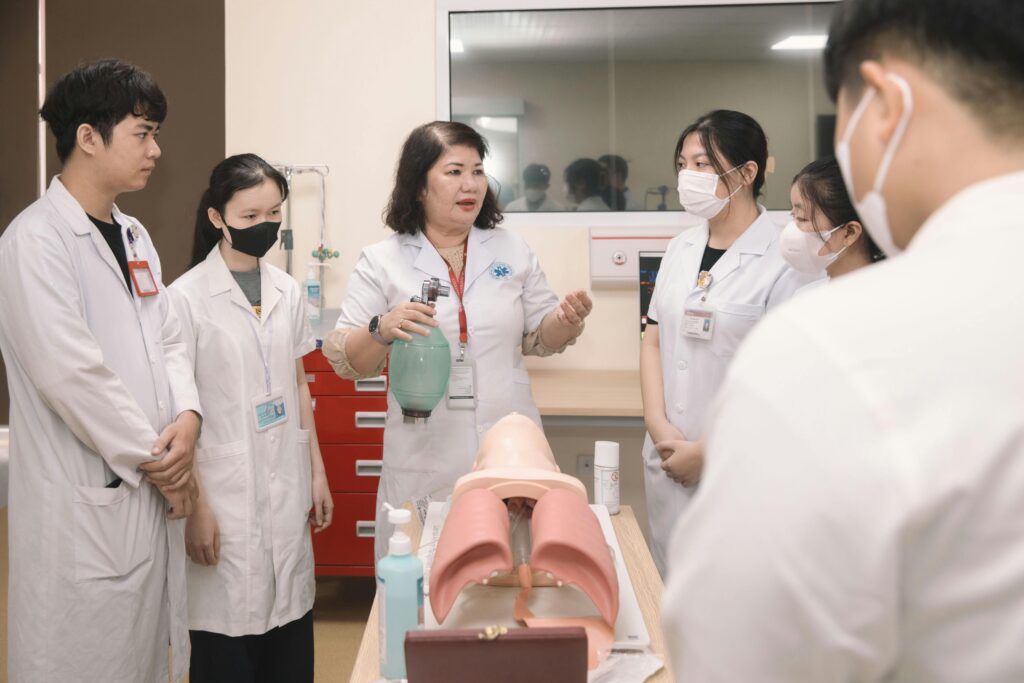
3. Healthcare & Nursing Management (Italy & Belgium)
In 2026, the European Union is facing its most significant demographic challenge: an aging population. Italy and Belgium have doubled their intake for international students in Nursing, Geriatric Care, and Healthcare Management. Unlike other fields, Healthcare offers a 100% employment rate within three months of graduation.
- Average Starting Salary: €45,000 – €60,000.
- The 2026 Advantage: Many Italian regions now offer a “Signing Bonus” of up to €5,000 for international graduates who commit to staying for at least three years.
- Career Path: Progress from a Clinical Manager to a Hospital Administrator.
4. Cybersecurity & Digital Infrastructure (Estonia & Ireland)
With the rise of 6G and AI-driven cyber threats, Estonia (the world’s most digital nation) and Ireland (the European HQ for Google and Meta) are desperate for Cybersecurity experts. In 2026, a degree in “Secure Cloud Systems” or “Cryptographic Engineering” is more valuable than a traditional Computer Science degree.
- Average Starting Salary: €70,000 – €95,000.
- Job Outlook: 10/10. Ireland alone reports a shortage of 15,000 cybersecurity professionals.
- Top Countries: Estonia (TalTech), Ireland (Trinity College Dublin).
Maximize Your Odds: The AI Student Writing Assistant
One major mistake students make in 2026 is using generic templates for their applications. Admission committees in Estonia and Ireland use advanced screening software to filter out “copy-paste” SOPs. This is why the AI Student Writing Assistant for Europe (2026) is your biggest asset. It is the only tool that stays updated with the specific “Key Skills” required for these high-demand degrees. It ensures your Motivation Letter highlights your ability to solve Europe’s current technical crises. If you want to bypass the rejection pile, this tool is your secret weapon to proving you are a high-value talent.
A professional European-style CV and a smartphone showing an AI-generated acceptance letter on a café table in Paris

5. Sustainable Architecture & Smart City Planning (Netherlands)
The Netherlands is the global leader in water management and sustainable urban living. In 2026, they are hiring thousands of architects and planners to rebuild European cities to be “Carbon Neutral.” If you study Sustainable Architecture here, you aren’t just learning to design buildings; you are learning to design the future of human survival.
- Average Starting Salary: €50,000 – €65,000.
- Unique Feature: The Dutch “Orientation Year” (Zoekjaar) allows you 12 months after graduation to find a job with zero bureaucracy.
- Top University: TU Delft (The world’s #2 for Architecture).
6. Digital Business & FinTech (France & Lithuania)
Paris has officially overtaken London as Europe’s financial capital in 2026, while Lithuania has become the world’s hub for FinTech startups. A degree in Digital Business or Blockchain Finance is perfect for those who want to work in the high-paced world of banking and digital payments.
- Average Starting Salary: €60,000 – €80,000.
- The “Post-Grad” Reality: Most graduates in Lithuania find work in “Unicorn” startups (companies worth over $1 billion) within weeks of finishing their exams.
Specializations for a Borderless Career in 2026
As we conclude our 2026 guide, it is essential to look at the sectors that are often overlooked but offer the fastest routes to an EU Blue Card. Whether you are planning your Monthly Expenses for International Students in Europe or searching for long-term stability, these four final degrees are the “Hidden Gems” of the European academic world.
A large international student fair in Berlin or Amsterdam with booths representing top European tech and engineering firms]
7. Agricultural Technology & Precision Farming (Hungary & Poland)
Europe is currently investing billions into “Food Security.” In 2026, Hungary and Poland have become the research labs for AgriTech. If you study “Smart Farming” or “Biotechnology in Agriculture,” you are entering a sector with zero competition and massive government subsidies.
- Average Starting Salary: €40,000 – €55,000.
- The 2026 Advantage: Most AgriTech programs in Hungary are fully covered by the [Stipendium Hungaricum Scholarship].
- Job Outlook: 9/10. Every agricultural firm is transitioning to AI-based farming.
8. Robotics & Industrial Automation (Sweden & Czech Republic)
Sweden’s manufacturing giants like Volvo and ABB, and the Czech Republic’s automotive hubs, are fully automating their factories in 2026. They don’t just need factory workers; they need “Robotics Engineers” who can program and maintain these systems.
- Average Starting Salary: €60,000 – €80,000.
- Top Countries: Sweden (KTH Royal Institute), Czech Republic (CTU Prague).
9. Supply Chain & Global Logistics (Greece & Germany)
With the 2026 expansion of European trade routes, “Logistics Management” has become a high-stakes career. From the Port of Piraeus in Greece to the DHL hubs in Germany, the demand for “Digital Supply Chain Managers” is at an all-time high.
- Average Starting Salary: €50,000 – €70,000.
- Career Path: Operations Manager, Logistics Analyst, or Sustainability Consultant.
A close-up of a student’s hands using the AI Writing Assistant on a smartphone to refine a cover letter for a logistics job]
10. Public Policy & Digital Governance (Belgium & France)
If your goal is to work for the European Commission or international NGOs, Brussels (Belgium) is your home. In 2026, degrees in “Digital Governance” are teaching students how to regulate the internet, AI, and global privacy.
- Average Starting Salary: €55,000 – €75,000 (Tax-free if working for EU institutions).
- Unique Feature: Networking in Brussels is the fastest way to a high-level diplomatic career.
Final Winning Strategy: Why Your SOP Must Be Flawless
The common thread between all these high-demand degrees is that they are highly competitive. In 2026, admission officers use AI to check for authenticity. If your Motivation Letter sounds like a robot wrote it, you will be rejected. This is why the AI Student Writing Assistant for Europe (2026) is non-negotiable. It helps you inject “Human-Centric” goals into your SOP while maintaining the professional tone required by European universities. It ensures your application highlights why you are the solution to Europe’s labor shortage.
A happy international graduate in a gown and cap, holding a degree and a job offer letter in front of the Eiffel Tower or Brandenburg Gate]
Common Rejections to Avoid in 2026
- Ignoring the “Skills Gap”: Don’t just apply for what you like; apply for what Europe needs.
- Weak CV: Use the European Style CV format. Generic resumes are ignored.
- Missing Deadlines: Most “Placement-Guaranteed” programs close applications by March 2026 for the September intake.
Conclusion: Your Roadmap to Success
Choosing a degree in 2026 is no longer about passion alone; it’s about strategic placement. By selecting one of these 10 fields and leveraging the AI Student Writing Assistant for Europe (2026), you aren’t just getting an education—you are securing a life in one of the world’s most stable and prosperous regions.
Stop dreaming and start applying. Gather your documents, use the AI tool to perfect your story, and take the first step toward your European career today!